

Since the arrival of ChatGPT, Gemini, Claude and Perplexity, a new discipline has emerged: Generative Engine Optimization, usually abbreviated as GEO. Organisations improve their content, websites and online presence so that they are mentioned more often in answers from AI systems.
That is a logical development. If customers use AI to find and compare brands, you want your organisation to appear in those answers. But being mentioned more often is not automatically better. Visibility only has value if AI also understands your brand well, positions it in the intended way and recommends it for the right reasons.
A brand that is not mentioned has a visibility problem. A brand that is mentioned, but is seen as outdated, weakly differentiated or unsuitable for the audience, has a different problem. More visibility can even reinforce that unwanted image.
That is where the difference between GEO and AI reputation begins.
GEO starts with visibility
GEO focuses on a brand’s presence in generative search engines and AI answers. Is the brand mentioned? In which answers does it appear? Which sources are cited? How can content be structured so that AI systems can find and use the information more easily?
Concrete activities follow from that. Organisations improve website structure, complete product information, publish relevant content and strengthen external sources. This can increase the chance that AI finds, mentions or cites a brand.
GEO is therefore an important operational discipline. It helps content teams, SEO specialists and digital marketers make online information ready for a new generation of search and answer systems.
For a CMO or board, however, knowing how often a brand is mentioned is not enough. They also want to know what image AI has of the brand, how that image relates to the intended positioning, and what this means for competition and growth.
AI reputation starts with the brand image
AI reputation therefore starts with a different question. Not: how do we get AI to mention us more often? But: what does AI say about our brand when we are mentioned?
AI systems do not form opinions the way people do. They combine patterns from training with information they may retrieve from the web. Still, their answers contain recognisable judgements. They describe some brands as expert, trustworthy or innovative. Other brands are framed as traditional, expensive, risky or weakly differentiated.
When different AI systems regularly attach such characteristics to the same brand, a recognisable AI brand image emerges. That image influences which brands an organisation is compared with, for which audiences it is considered relevant, and in which situations it is recommended.
AI reputation therefore examines not only whether a brand is present, but also how it is assessed, understood, positioned and recommended.
The four KPIs of AI reputation
AIRepScore is an AI Brand Intelligence tool. As its methodology, the tool uses the AIRepScore Framework, which measures AI reputation through four related KPIs.
AI Credibility shows whether AI systems regard the brand as credible, clear and relevant. It looks at authority, brand clarity, trust, strategic relevance, differentiation and sentiment.
AI Brand Perception maps the image behind the brand name. Which characteristics, strengths, weaknesses and associations does AI connect to the brand? Does AI understand what the organisation stands for, and does that match the intended positioning?
AI Positioning shows which brands and alternatives the organisation is compared with. This reveals who AI considers the real competitors, on which points brands differ, and where their positioning strongly overlaps.
AI Recommendation examines when, why and for which audience AI recommends a brand. That outcome depends on the question, the market, the audience and the situation in which someone is making a choice.
Together, these four KPIs form a brand’s AI reputation profile.
Visibility does not yet show what needs to change
Suppose a brand is mentioned often, but is mainly seen as reliable and traditional. The organisation wants to be known as innovative. A GEO analysis can show in which answers and sources the brand appears. An AI reputation analysis makes clear that the real problem lies in brand perception.
Publishing more content alone will not automatically change that perception. The organisation must first determine which evidence of innovation is missing, which propositions are insufficiently recognised, and which external sources confirm the existing image.
Another brand may have strong credibility but hardly be recommended to smaller companies. The cause may lie in product information, how audiences are described, how the offering is positioned, or the strength of a competitor in that specific market. In that case too, general visibility is not the full explanation.
AI reputation helps establish the cause first. After that, it becomes much clearer which content, sources, product data or positioning choices need to be improved.
From technical optimisation to strategic steering
In practice, AI visibility is still often treated as an extension of SEO. The conversation then centres on prompts, mentions, citations, content formats and technical adjustments. Those are useful topics, but they do not yet show what AI means for an organisation’s brand and market position.
AI reputation brings the subject to the level of brand strategy and management. It shows where positioning is strong or weak, which audiences are well served, which audiences fit less well, and which alternatives AI places in the same choice.
That makes the outcomes useful beyond content optimisation. They can lead to sharpening positioning, explaining a proposition more clearly, completing product information, strengthening proof points, or exploring a new growth opportunity.
For specialists, the analysis guides execution. For CMOs and boards, it makes visible why action is needed and which topics deserve priority.
Different models, different brand images
An assessment by one AI system is a snapshot. Models can use different sources, training data and retrieval methods. As a result, they can assess the same brand differently.
AIRepScore therefore examines several leading AI systems with the same methodology. This shows where models reach similar conclusions and where their perceptions diverge.
Where possible, the tool also distinguishes between the brand image built into a model and current information retrieved from the web. That helps an organisation see whether older associations are still dominant and whether recent communication already influences AI answers.
This provides more insight than an overview of mentions alone. It shows how firmly a perception is held, where it comes from, and whether the image is moving in the intended direction.
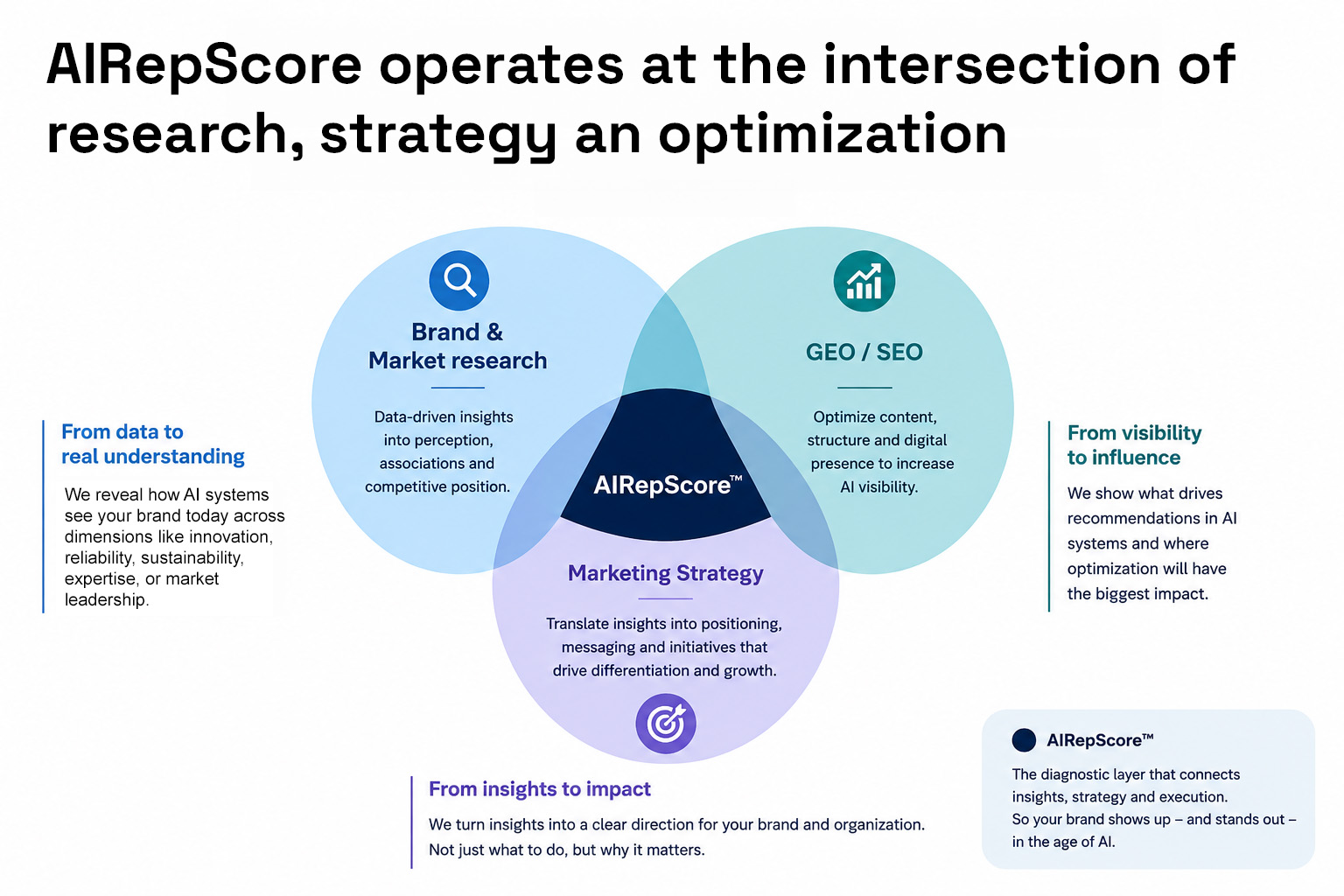
GEO and AI reputation complement each other
GEO and AI reputation do not compete with each other. They answer different questions within the same field of work.
GEO shows how an organisation can improve its presence in AI answers. AI reputation shows which brand image needs to be strengthened or changed, and which strategic goals should come first.
AI reputation analysis therefore gives direction to GEO. If the problem is mainly visibility, the emphasis can be on content, structure and external sources. If AI misunderstands the brand, a sharper brand message is needed first. If the brand is recommended to the wrong audience, positioning, propositions and audience information need to be revisited.
By combining both disciplines, you prevent optimisation from becoming an end in itself.
From GEO to AI reputation management
Being visible in AI remains important. But organisations also need to know what AI says about their brand, who it compares them with, and at which moments it recommends them.
GEO helps make a brand more findable. AI reputation helps ensure the brand is understood, positioned and recommended in the right way.
AIRepScore makes this brand image measurable and tracks how it develops. That creates a foundation for focused AI reputation management and for better decisions on positioning, communication and growth.