


Four KPIs for AI brand reputation
People increasingly ask AI which companies to trust, which brands matter, which suppliers to compare and which products or services to choose. Models from OpenAI, Anthropic, Google, Mistral and others are becoming a decisive layer between customer and brand. They can strengthen your reputation — or quietly erode it.
AI does not form opinions the way people do. During training, models absorb patterns from millions of sources: websites, articles, product pages, reviews, expert content, news and customer discussions. Those patterns become the foundation of how AI perceives a brand.
A model’s trained knowledge freezes at release and is only refreshed when a new version ships — often every six to eighteen months. Applications such as ChatGPT, Copilot and Gemini therefore add live web search on top of that foundation. AIRepScore measures both: the structural trained view and the influence of current web signals.
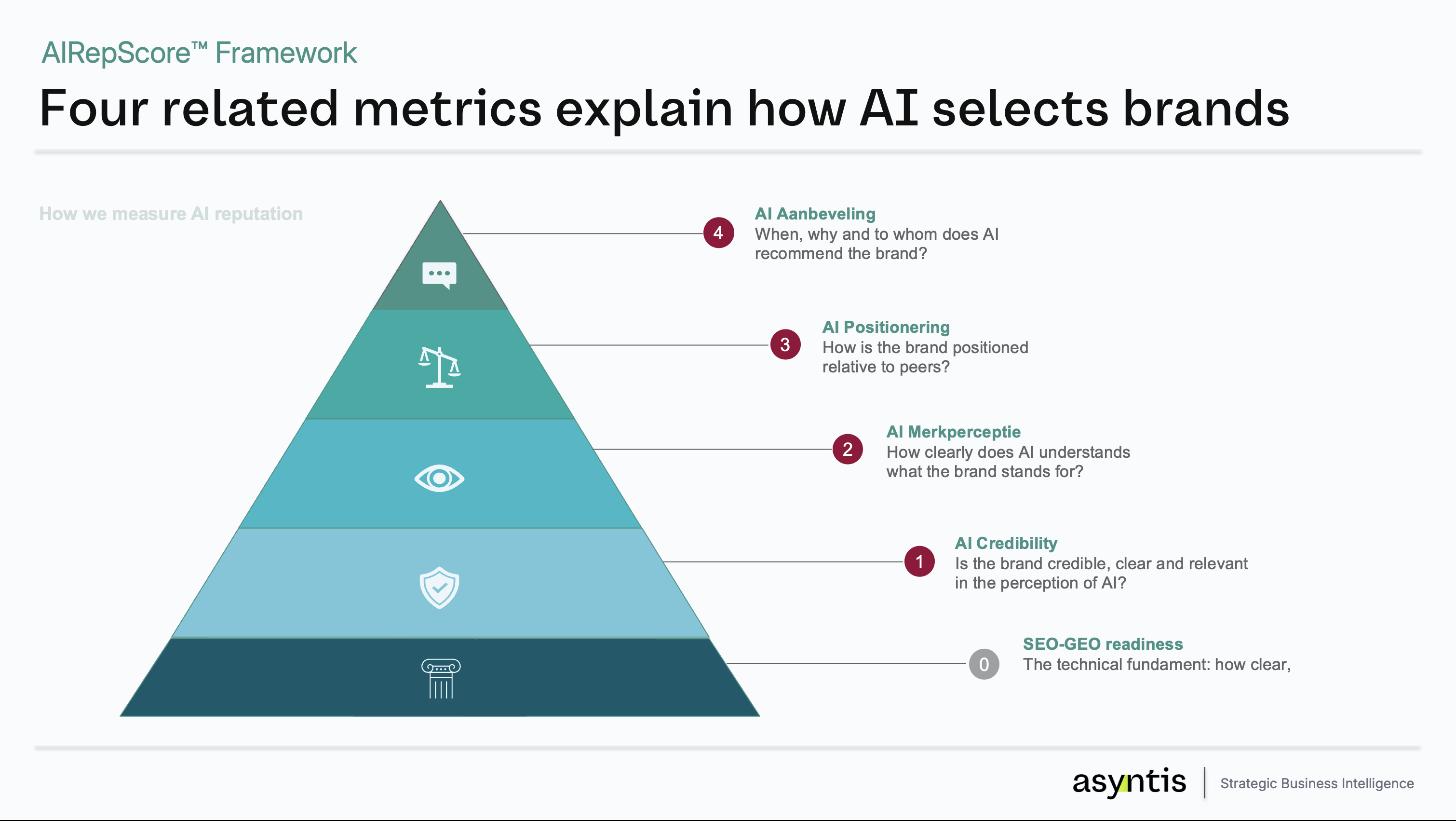
The AIRepScore™ Framework is an analytical model for how AI processes brand-related questions. It structures measurement across four related KPIs:
- AI Credibility
- AI Brand Perception
- AI Positioning
- AI Recommendation
Together they form a complete AI reputation profile — not one overall score, but four coherent views on the same brand.
1. AI Credibility
Credibility is the foundation. Before AI recommends a brand, it needs a clear, believable picture of that brand. Six dimensions matter here: authority, brand clarity, trust, strategic relevance, differentiation and sentiment. If those signals are weak, fragmented or unclear, AI may still know the company exists — but it is far less likely to treat it as a reliable option for users.
AIRepScore measures these six dimensions model by model, across the AI systems most relevant for your market, region and business type.
It also separates trained knowledge from live web retrieval. In the dashboard this appears as a web search correction: how recent online signals — site updates, reviews, coverage — shift how AI-facing apps talk about your brand.
AI Credibility answers the question:
How credible and trustworthy is your brand in the eyes of AI?
2. AI Brand Perception
Once AI has a credible picture of a brand, it forms associations about what the brand stands for. Is it seen as innovative, sustainable, premium, affordable, reliable, expert, customer-focused or emotionally appealing?
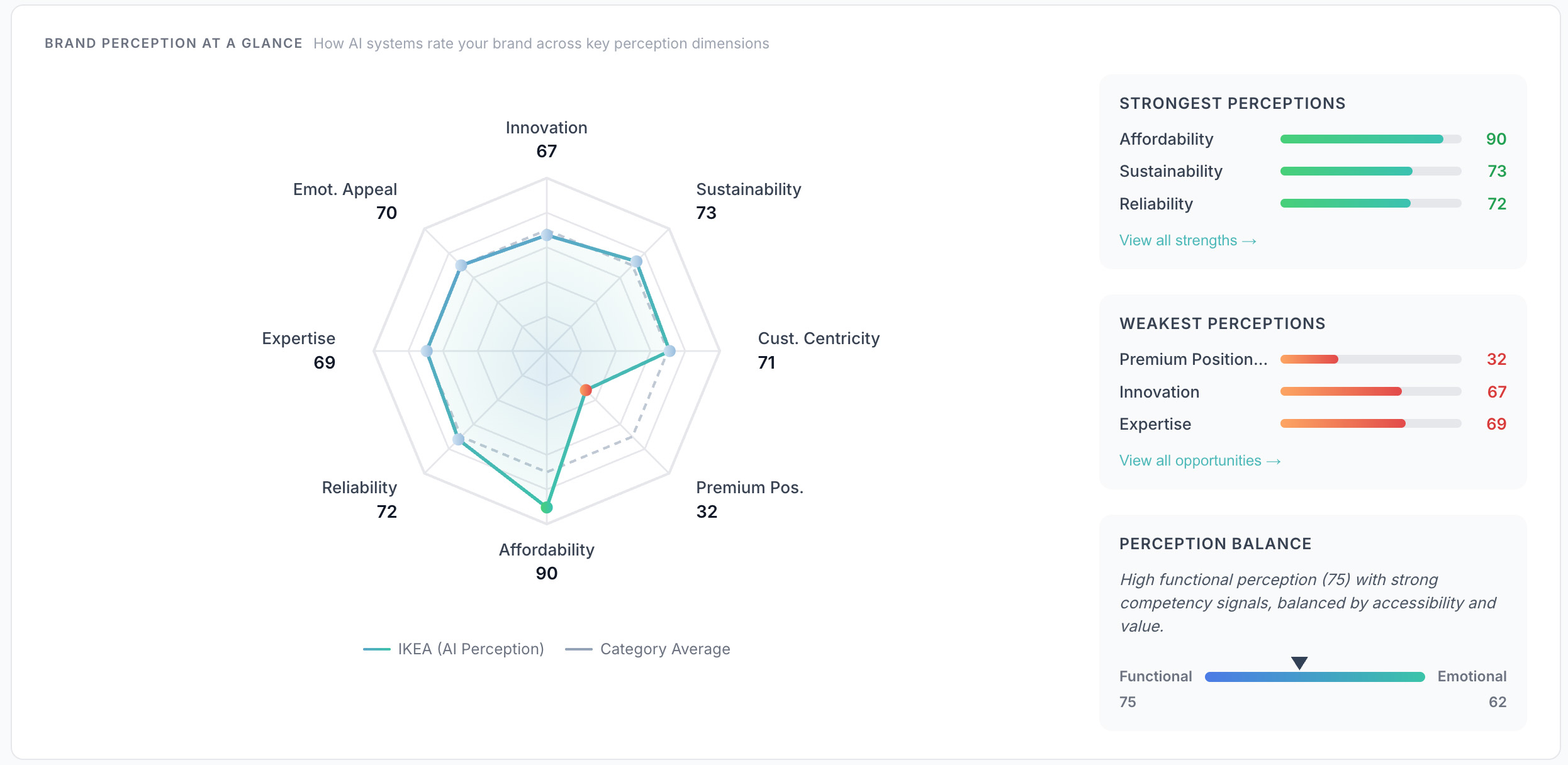
Those associations come from repeated patterns in training sources. They are structural and slow to change — which is why managing AI brand perception requires a long-term approach to positioning, content and communication.
AI Brand Perception answers the question:
How clearly does AI understand what your brand stands for?
3. AI Positioning
AI rarely evaluates brands in isolation. In real decisions, people ask AI to compare alternatives. Your brand is therefore positioned relative to peers and competitors. One brand may look more trusted, another more innovative, another more suitable for a specific market or need.
AI Positioning answers the question:
How does AI place your brand relative to others in your market?
4. AI Recommendation
Ultimately, what matters is whether AI advises your brand to the right person at the right moment. Strong credibility and clear perception do not automatically mean recommendation in every situation. That depends on use case, persona, region, category and decision context — for example a premium buyer, a price-sensitive buyer or a technical B2B procurement scenario.
AIRepScore measures two types of recommendation:
- Spontaneous recommendation — what AI suggests without being given a shortlist, based on trained knowledge.
- Assisted recommendation — how AI ranks your brand when alternatives are in view, mirroring how people ask AI to compare options in practice.
AI Recommendation answers the question:
How likely is AI to recommend your brand in a specific use case or decision context?
Why these four KPIs matter
The four KPIs build on each other. AIRepScore uses them to create a layered picture: how well does AI know and trust this brand, what does it associate with it, how does it position it against alternatives, and in which contexts does it recommend it? That is why AI reputation is not a single number. It is a structured framework of related metrics.
For organisations, AI creates a new brand challenge. Visibility in search or social media is no longer enough. Brands also need to understand how AI systems interpret them, compare them and recommend them — and how that view holds up against current online signals.
From SEO to AI reputation management
We believe the AI era becomes increasingly clickless. That calls for a new standard for measuring visibility and brand value. The AIRepScore™ Framework helps organisations see how AI systems perceive their brand today, how that perception changes over time, and where the biggest opportunities for improvement lie. In the AI era, reputation is no longer only human.
94% of business buyers report using AI in their buying process.
Forrester, January 22, 2026
AIRepScore makes brand reputation and AI perception measurable across the models that matter for your brand — in the context of your audiences, geography and B2B or B2C setting. It gives organisations a structured way to track how that picture changes and where to act, strategically and operationally.