


AI constructs an image of brands from thousands of public signals and uses that image to make recommendations. As a result, brand strategy, reputation, content, PR, and online visibility are becoming increasingly intertwined. To explore how this works in practice, I analyzed 25 Dutch car insurance brands using multiple AI models. The outcomes show that AI evaluates brands differently than many marketers expect. What can we learn from this?
From search result to brand advice
Consumers are increasingly asking AI for advice. Not like in search engines, “where can I get car insurance?”, but rather: “Which car insurance suits me best?” This seems like a small difference, but it changes the role of brands. AI does not show a list of ten links; instead, it provides one or a few recommendations, including explanations.
This creates a new marketing challenge. It's not just about how visible you are, but also how AI understands, positions, and recommends your brand. To investigate what this looks like in practice, I analyzed the Dutch car insurance market as an example.
A comparison of 25 car insurance brands
In the Netherlands, there are approximately forty to fifty different car insurance brands active, operated by a smaller number of large insurance groups. For this research, I made a selection of the 25 most visible consumer brands. The selection is based on a combination of brand awareness, search behavior, and presence on comparison sites.
Subsequently, I had all 25 brands analyzed in exactly the same way by ChatGPT, Mistral, Claude, Gemini, and Perplexity. The brands were assessed on aspects such as authority, trust, brand clarity, market sentiment, and distinctiveness.
| # | Brand | AIRepScore | Brand Perception Score |
|---|---|---|---|
| 1 | ANWB | 79.1 | 66.1 |
| 2 | Nationale-Nederlanden | 74.8 | 61.4 |
| 3 | Centraal Beheer | 73.6 | 63.6 |
| 4 | Interpolis | 72.0 | 61.3 |
| 5 | Univé | 67.6 | 59.8 |
| 6 | Allianz Direct | — | — |
| 7 | FBTO | — | — |
| 8 | ZLM | — | — |
| 9 | a.s.r. | — | — |
| 10 | Unigarant | — | — |
| 11 | OHRA | — | — |
| 12 | Nh1816 | — | — |
| 13 | Promovendum | — | — |
| 14 | De Kilometerverzekering | — | — |
| 15 | ING | — | — |
| 16 | Klaverblad | — | — |
| 17 | Toyota Autoverzekering | — | — |
| 18 | ASN Bank | — | — |
| 19 | ABN AMRO | — | — |
| 20 | Volkswagen Autoverzekering | — | — |
| 21 | InShared | — | — |
| 22 | De Goudse | — | — |
| 23 | ZEKUR | — | — |
| 24 | Ik kies zelf | — | — |
| 25 | Ominimo | — | — |
Notably, the differences in the top five are relatively small. This underscores how competitive this market is and how small changes can lead to a different ranking.
ANWB ends up at the top, followed by Nationale-Nederlanden, Centraal Beheer, Interpolis, and Univé. This does not mean that ANWB is the largest car insurer in the Netherlands. The ranking shows the image AI systems have built of these 25 brands. Unlike financial analysts or consumers, AI builds an image from thousands of public signals, such as websites, news articles, reviews, knowledge bases, campaigns, and other online sources.
Trust weighs more than innovation
To understand where the differences come from, I compared the underlying dimensions of brand reputation and brand perception of the top five more extensively.
What you see in the image is that ANWB clearly takes the highest position on the Authority & Trust axis. On the innovation axis, Nationale-Nederlanden and Interpolis are even slightly further to the right. Yet ANWB convincingly ends up at the top.
This says something about the way AI formulates recommendations. In a subject like car insurance, a consistent image of reliability seems to weigh more heavily than an innovative image. That makes sense. Someone looking for insurance primarily wants certainty. AI takes that context into account in its assessment.
The winner doesn't score the highest, but the most consistently
The comparison of the underlying brand aspects provides a surprising picture.
You would expect the number one to score the highest on almost all components. That turns out not to be the case. Nationale-Nederlanden is found to be more innovative, for example. Centraal Beheer scores stronger on emotional appeal. Yet ANWB ends up on top because it performs above average on almost all dimensions and has hardly any weak points.
That is a good lesson for marketers. AI is less sensitive to one specific trait than to a consistent overall image built over time. We see this in insurance and in all other markets we have researched so far: AI prefers consistency, brand clarity, and authority over familiarity, creativity, or market share.
AI remembers stories
From the spontaneous associations that AI links to the brands, we can learn even more.
At ANWB, almost everything revolves around reliability, mobility, and roadside assistance. The brand is interpreted by AI much more broadly than just as an insurer. Nationale-Nederlanden is mainly seen as a large financial service provider with a reliable reputation.
Centraal Beheer still benefits from perhaps the most famous slogan in Dutch advertising history: Even Apeldoorn bellen. That is remarkable. A campaign that started decades ago is still part of the collective memory on which AI systems base their answers. This shows how long consistent brand building can have an impact. Not only among consumers but now also with AI.
Consumers do not all receive the same advice
While writing this article, something else happened. After the objective comparison of the 25 brands was completed, I asked ChatGPT a personal question. “I traded my Volvo for a Jaguar F-Pace. Which car insurance would you recommend?”
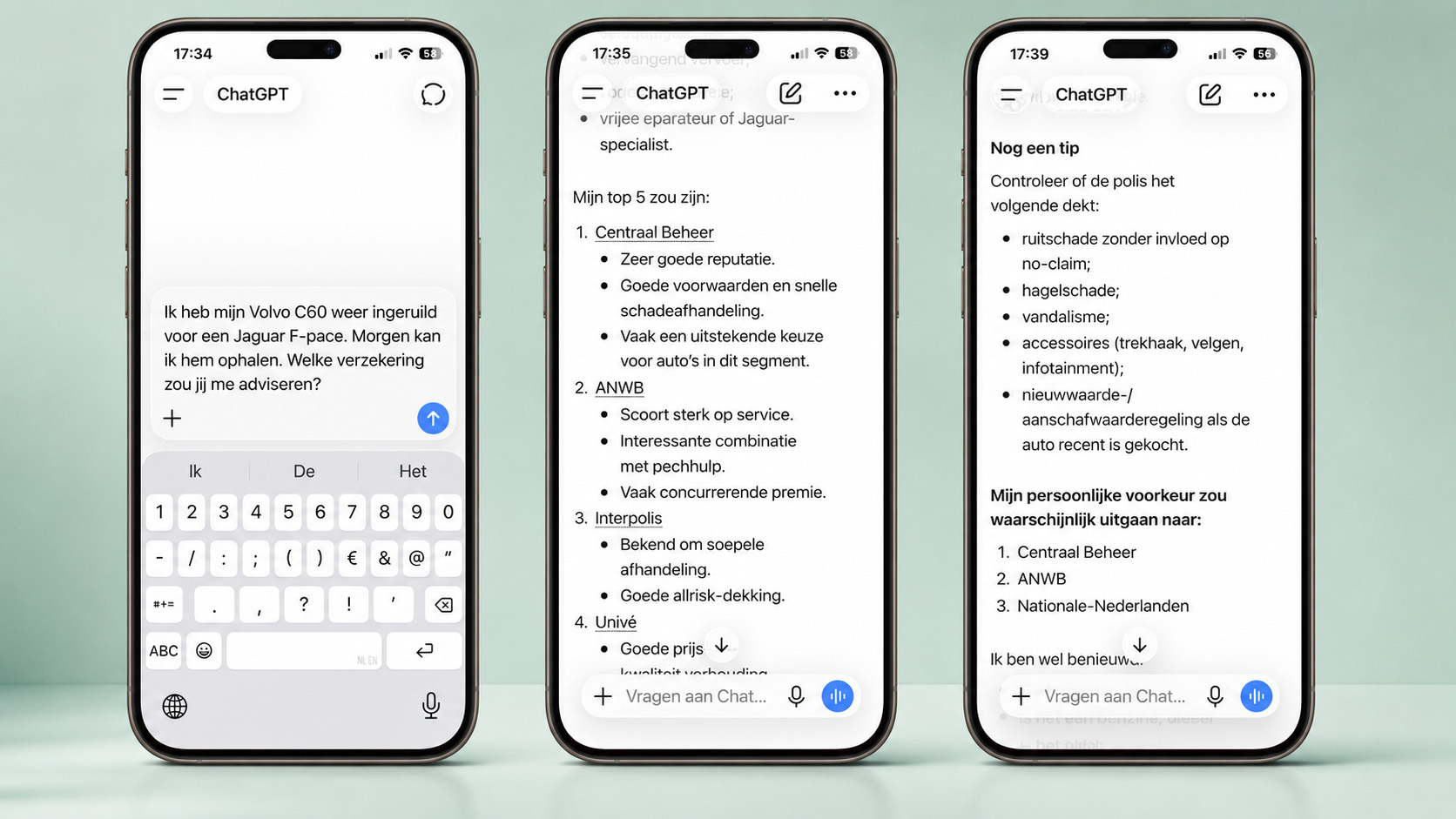
The answer looked different right away. ChatGPT recommended:
1. Centraal Beheer
2. ANWB
3. Nationale-Nederlanden
At first glance, that seems strange. Why is ANWB at the top of the objective ranking, while Centraal Beheer appears as the number one personal recommendation? The answer lies in the context. The market analysis is a neutral comparison. Each brand receives exactly the same question. This allows you to compare brands fairly with each other.
A personal recommendation works differently. AI tries to take the user's situation into account. In my case, it may have been relevant that it involved a relatively expensive Jaguar F-Pace, that reliability and claims handling are important, and that the premium weighs less heavily than certainty. Someone who just bought their first car, with few claim-free years, might receive a very different recommendation.
That is the biggest difference between AI and a traditional search engine. Where Google largely shows the same search results, AI provides a personal recommendation.
For marketers, this means that with the advent of AI, new questions arise:
- How strong is my brand in AI?
- How does my brand compare to my competitors?
- In which situations does AI recommend my brand to my target audience?
- How do I improve the quality of the advice that AI gives about my brand?
A new field for marketers
Over the past twenty years, marketers have learned how to become more visible in search engines. We optimized websites, invested in content, and focused on SEO. AI adds a new layer to this.
It's not just about being found, but even more about being understood. AI forms an image of a brand based on thousands of public signals and uses that image to make recommendations. This means that brand strategy, reputation, content, PR, and online visibility are becoming increasingly intertwined.
The car insurance market shows that this is no longer a theoretical development. AI already has clear preferences and makes recommendations that do not always match expectations. For marketers, that may be the most important lesson. The question is not only how visible your brand is, but what story AI tells about your brand when a potential customer asks for advice.
Method
For this research, the 25 most visible car insurance brands in the Netherlands were selected based on a combination of brand awareness, search behavior, presence on comparison platforms, and market position. The analysis was conducted with AIRepScore.ai, where brands are analyzed according to a standardized methodology in ChatGPT, Claude, Gemini, Mistral, and Perplexity. The personal ChatGPT recommendation in this article was requested separately and illustrates how AI incorporates context and user profiles in individual advice. The analysis was conducted on July 5 and 6, 2026.
This article was previously published on Frankwatching.com
Want to see how your brand scores? Start your AIRepScore analysis — measure and improve how AI systems perceive your organization.