


Benchmark research among twenty Dutch health insurers shows how AI systems like ChatGPT and Claude position and advise brands, even before the consumer has visited an insurance website. Zilveren Kruis emerges as the strongest brand, closely followed by DSW and a.s.r.
Where consumers have long started their search for health insurance on comparison sites like Independer or Zorgkiezer, that initial orientation is increasingly shifting to AI assistants like ChatGPT, Gemini, Claude, and Perplexity. Questions like “Which health insurer suits me best?” or “Which insurer is known as reliable?” are increasingly being asked directly to AI.
This leads to a fundamental change in the customer journey. AI systems no longer function solely as search engines but are increasingly taking on the role of personal advisor. They compare brands, weigh arguments, and make recommendations, often before a consumer has visited a website.
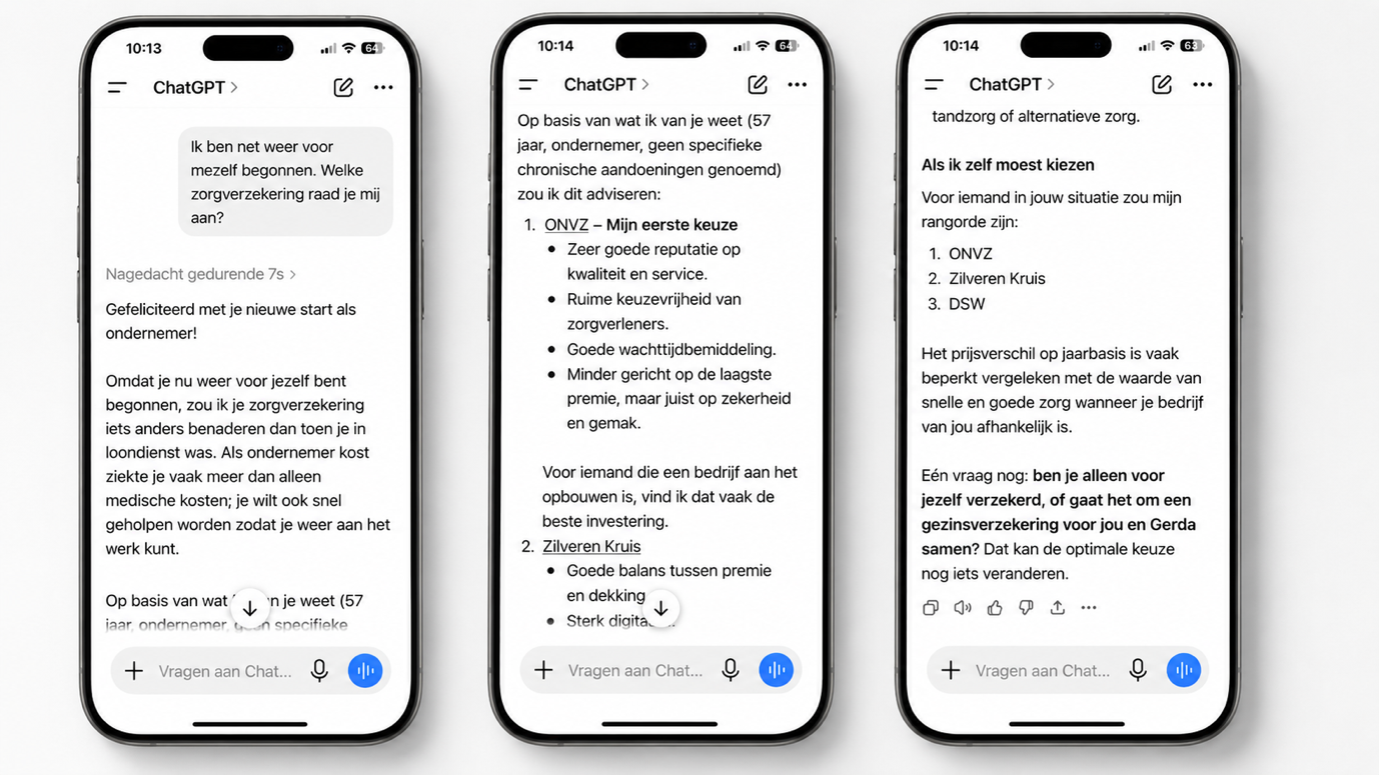
Due to the advisory role of AI, it is becoming increasingly important for organizations to gain insight into a new form of brand reputation: not how consumers view a brand, but how AI systems interpret, position, and recommend a brand.
Zilveren Kruis at the top
For this benchmark, AIRepScore analyzed twenty Dutch health insurers using several leading AI models, including GPT, Claude, Gemini, Mistral, and Perplexity.
Zilveren Kruis achieves the highest AIRepScore with 72.5 points, followed by DSW, a.s.r., Menzis, and Interpolis. Notably, the differences between them are small. This shows how competitive the Dutch health insurance market is and how relatively small changes can influence future recommendations.
Top 5 market ranking
| # | Brand | AIRepScore | Brand Perception Score |
|---|---|---|---|
| 1 | Zilveren Kruis | 72.5 | 58.6 |
| 2 | DSW | 72.0 | 58.4 |
| 3 | a.s.r. | 71.7 | 61.2 |
| 4 | Menzis | 71.1 | 57.1 |
| 5 | Interpolis | 70.0 | 61.3 |
AI assesses more than just familiarity
The ranking is explicitly not a popularity list or market share measurement. AI systems form their judgment based on thousands of signals from training data, current web information, and the way organizations position themselves. Factors such as authority, brand clarity, trust, relevance, and distinctiveness play an important role in this.
That's why interesting differences arise. Zilveren Kruis is not at the top because it achieves the highest score on every dimension. The brand stands out mainly due to exceptionally high strategic relevance and very consistent recognition across different AI models. AI easily understands what the brand stands for and in which situations it is relevant.
DSW shows the highest trust score of the entire top five, while a.s.r. stands out for exceptionally high brand clarity and a very consistent reputation across different AI models. This shows that AI does not identify one universal winner but recognizes different strong brand profiles.
Different brands, different roles
The competition map makes these differences visible.
Zilveren Kruis is located in the quadrant where relatively high authority is combined with an innovative positioning. DSW is right next to it, but AI interprets it as slightly more traditional and it scores exceptionally high on trust.
a.s.r. also positions itself as a reliable player, but according to AI, it combines this more strongly with sustainability and social responsibility.
Interpolis is seen by AI as relatively innovative, while Menzis mainly occupies a solid and reliable middle position.
Notably, none of the five brands deviates extremely. The differences are subtle, but it is precisely these nuances that ultimately determine which brands AI recommends more readily.
Zilveren Kruis wins on AI reputation, but not on every perception dimension
When looking at the broader brand perception, an interesting picture emerges once again
Zilveren Kruis scores strongly on customer orientation, reliability, and expertise. At the same time, the AI models see room for improvement in terms of affordability and sustainability.
DSW, on the other hand, is strongly associated with affordability, customer service, and reliability. a.s.r. distinguishes itself mainly in sustainability and responsible entrepreneurship.
This shows that AI not only creates a ranking but also assigns different roles to brands within the same market.
What AI spontaneously associates with these brands
Perhaps even more interesting are the spontaneous associations that AI links to the different brands. Dominant associations from the Brand Perception scan — top 3 by AIRepScore; font size reflects relative strength.
At Zilveren Kruis, concepts such as health insurance, reliability, and market leadership dominate. AI clearly positions the brand as an established player within the Dutch healthcare market.
DSW, on the other hand, evokes words like fair prices, affordability, customer service, and customer-friendly. The brand is mainly seen as accessible and affordable.
a.s.r. is primarily associated by AI with Reliability, Responsibility, and Sustainability. This creates a distinctly different profile, where reliability is combined with social responsibility.
These spontaneous associations are important because such first impressions play a significant role when AI systems make recommendations to consumers.
AI does not give everyone the same advice
An important insight from the research is that there is no single "best" health insurer. When ChatGPT is asked for advice, it often gives a different answer depending on the situation. Age, family composition, additional needs, price sensitivity, or preference for sustainability ensure that AI makes different recommendations.
Yet, every recommendation starts with the same foundation: how AI understands a brand. This is precisely why AI Reputation is becoming a new strategic marketing discipline. Organizations will need to think not only about how people perceive their brand but also about how AI systems interpret their brand and include it in personalized recommendations.
From SEO to AI Reputation
For years, online visibility was mainly about search engines. Now the focus is shifting to AI platforms that increasingly form the first step in the customer journey.
This requires a new way of looking at brand management. Not only findability becomes important, but also the quality, consistency, and credibility of all the information on which AI bases its judgment.
The benchmark among Dutch health insurers shows that the differences between brands are small. That is precisely why relatively limited improvements in AI reputation can soon make the difference between being mentioned or not when AI is asked for consumer advice.
Method
This report ranks twenty brands in Dutch health insurers. The top five leaders are assessed with the full AIRepScore framework (GPT-4o, Claude, Gemini, Mistral, Perplexity + Live Web Signal) and Brand Perception scans. Positions 6–20 reflect the broader market ranking.
Want to see how your brand scores? Start your AIRepScore analysis — measure and improve how AI systems perceive your organization.