


How ChatGPT, Gemini, Claude and Mistral recommend your brand, products and services
For years, brands focused on search engines, social media and human influencers to shape perception and drive decisions. The landscape is changing rapidly. Increasingly, AI systems such as ChatGPT, Gemini, Claude and Microsoft Copilot are becoming the first layer between people and information.
Consumers ask AI which running shoes to buy. Engineers ask AI which industrial supplier is most reliable. Procurement teams ask AI which software vendors are market leaders. Executives ask AI to summarize competitors, compare solutions and recommend strategic options. In many cases, AI is no longer just retrieving information. It is interpreting, filtering and recommending. That changes how brands are discovered, compared and trusted.
AI systems are not neutral search engines
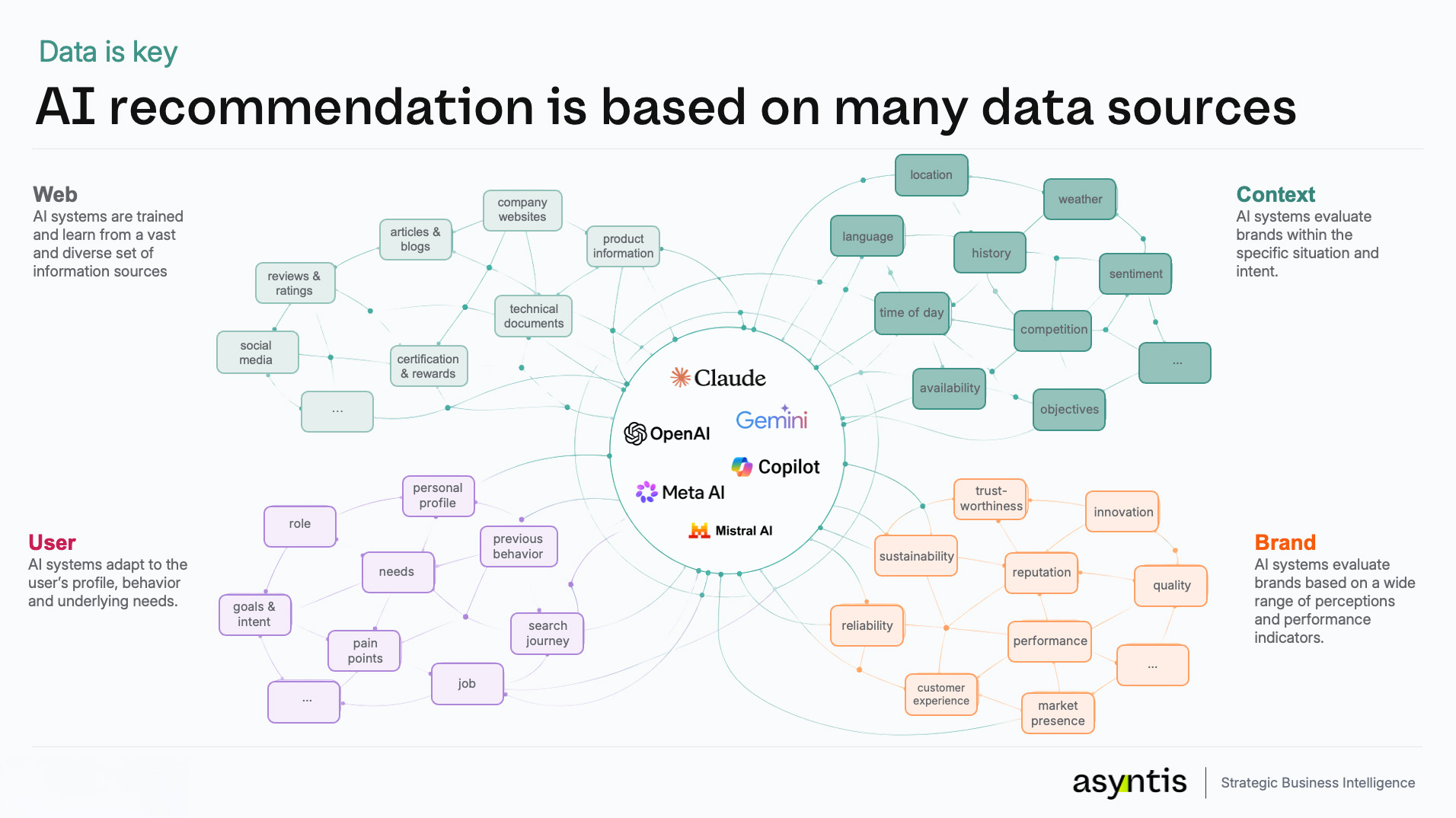
Large language models do not simply return a list of links. They generate responses, based on patterns they have absorbed during training. Over time, AI models begin to associate brands with certain characteristics:
- innovative or outdated
- reliable or unreliable
- premium or affordable
- sustainable or not
- trustworthy or risky
- category-leading or peripheral
These patterns and associations influence whether a model recommends your brand in a specific context or that it will recommend one of your peers. During recommendation most AI applications add actual online signals thru a web search layer and combine them with the model's trained knowledge. This can strengthen or weaken the recommendation.
AIRepScore measures both layers: the structural trained perception (core knowledge) and the influence of real-time online signals. This makes it possible to see not just what score you have today, but whether recent online content is pushing that score up or down and by how much.
The Three Layers of AI
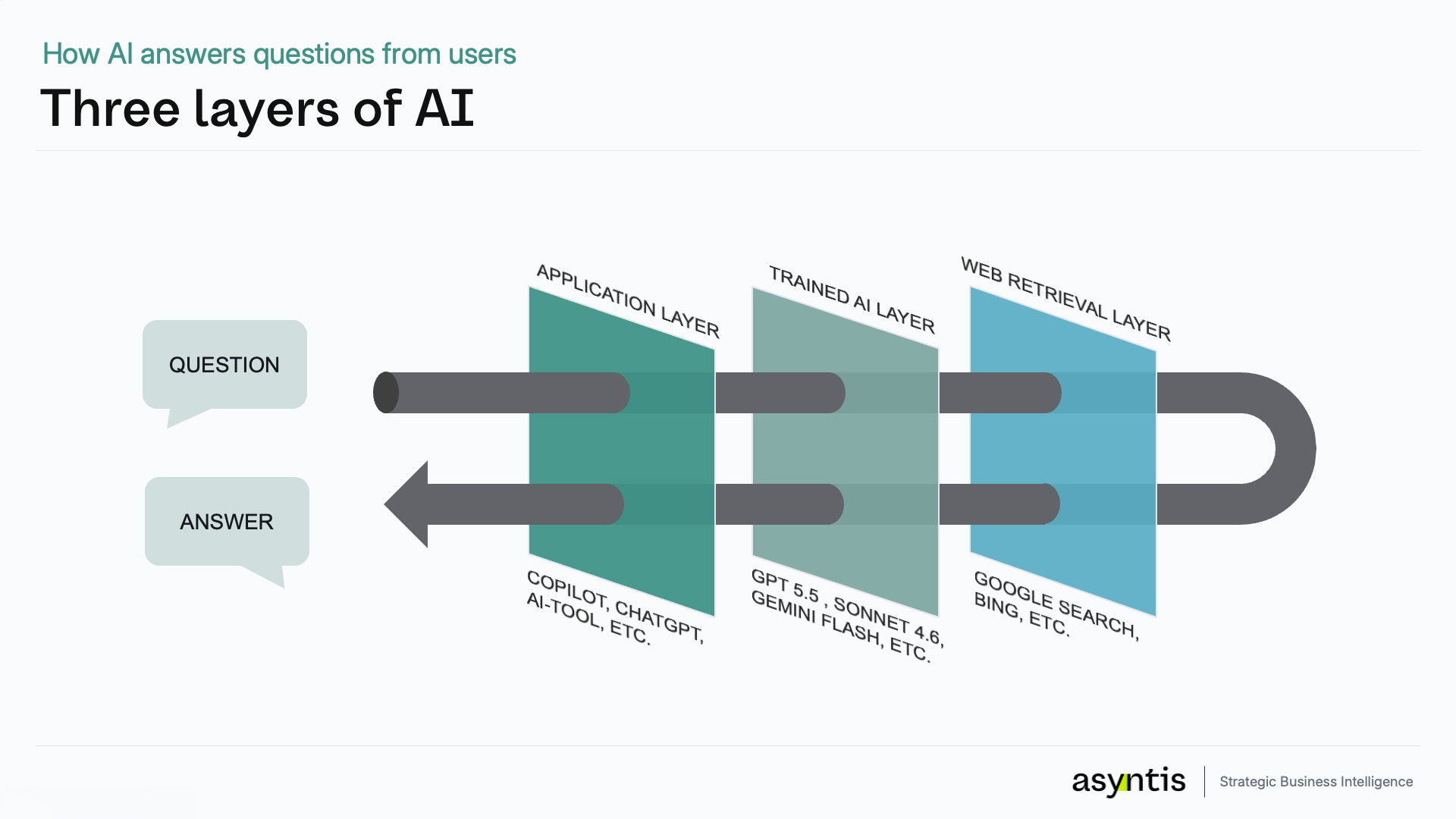
AI applications such as Copilot and ChatGPT generally do not respond solely based on their trained knowledge. When a user submits a question, the system typically processes it through three distinct layers:
- Application Layer
- Trained AI Layer
- Web Search Layer
1. Application Layer
The first layer is the application itself — the interface through which users interact with AI. This layer is optimized for the tasks users perform and may store its own local data sources, preferences, and user profiles based on previous interactions.
The application layer often has access to contextual information such as the user’s history, location, time of day, device, language preferences, and the specific task being performed. This context helps shape how questions are interpreted and how responses are presented.
2. Trained AI Layer
AI applications rely on underlying foundation models. These models learn from vast amounts of data and diverse information sources during their training process, up until the point at which a specific model version is released.
Once released, a model’s knowledge is generally fixed. The associations, perceptions, and understanding it has developed about brands, industries, products, and topics become largely embedded within that version of the model. These perceptions are only updated when a new model version is trained and released using more recent information.
As a result, every AI model develops its own internal representation of brands, markets, and competitive landscapes based on the data it was exposed to during training.
3. Web Search Layer
The third layer is the web retrieval or web search layer.
When an AI system receives a question, it may interpret the request and generate one or more search queries that are sent to an associated search engine, typically Bing, Google, or another retrieval service. The purpose is to determine whether recent information should influence or modify the model’s existing understanding.
This retrieval process allows the AI system to incorporate current events, newly published content, recent reviews, news articles, and other information that was not available when the underlying model was trained.
In effect, the web search layer enables the AI system to supplement its trained knowledge with real-time signals from the internet.
How the Layers Work Together
The final response is generated by combining signals from all three layers and is then delivered in the tone, style, and user experience defined by the application layer.
As a result, every answer is unique and influenced by:
- The context and profile of the user (Application Layer)
- The embedded knowledge and brand perceptions of the underlying AI model (Trained AI Layer)
- Recent information retrieved from the web (Web Search Layer)
AIRepScore measures both the trained brand perception embedded within leading AI models and the influence of web search on those perceptions. The platform evaluates these effects across different use cases, decision-making contexts, and customer personas to provide a comprehensive view of how AI systems perceive, position, and recommend a brand.
What AIRepScore measures
AIRepScore measures more than visibility alone. The framework evaluates how AI systems:
assess your brand’s credibility → AI Credibility
understand what your brand stands for → AI Brand Perception
position you against alternatives → AI Positioning
and recommend you in concrete situations → AI Recommendation
Together these four related KPIs form an AI reputation profile — not one overall score. The AIRepScore Framework reflects how AI systems influence actual decision making and provides structured insight into how likely AI systems are to recommend your business, brand or products in a real-world use case or decision scenario.
Why AIRepScore measures ecosystems, not just chatbots
AIRepScore does not simply test your brand on one AI app. The platform measures the foundation models that underpin the dominant AI ecosystems influencing business and consumer decisions globally. This distinction matters because many AI assistants, apps, enterprise systems and tools are built on top of the same underlying foundation models.
Example: Microsoft Copilot.
Copilot is a widely used AI interface within enterprise environments, deeply integrated into Microsoft 365, Teams, Windows and enterprise workflows. However, Copilot is not a standalone foundation model. It relies on OpenAI's models within the Microsoft ecosystem. To avoid double-counting, AIRepScore measures the underlying foundation models and weights their influence accordingly.
The AI ecosystems currently included in AIRepScore
The current AIRepScore methodology focuses on the AI ecosystems that are most influential in European and North American business and consumer decision making. The core foundation models currently used are:
- OpenAI / GPT — powers ChatGPT, Microsoft Copilot and many enterprise integrations
- Google Gemini — powers Google Search AI, Workspace and Android AI features
- Anthropic Claude — used in enterprise tools, coding assistants and safety-focused applications
- Perplexity AI — widely used by professionals for research, analysis, and business intelligence
- Meta AI / Llama — coming soon; powers Meta AI across WhatsApp, Instagram, and Facebook
- DeepSeek — available on request; widely used in China and other parts of Southeast Asia
Additional regional ecosystems may be introduced over time as the framework expands internationally.
Different markets require different AI weighting models
Not every AI system has the same influence in every market. Enterprise decision making in Europe differs significantly from consumer behavior in the United States or Asia. Some AI systems dominate workplace productivity, while others have stronger influence within search, mobile or social ecosystems.
For that reason, AIRepScore uses weighted AI panels that vary by B2B or B2C profile, geography and ecosystem relevance. In a B2C context, Gemini and GPT-4o receive equal weight because both dominate consumer-facing AI touchpoints. In a B2B context, GPT-4o receives higher weight because of its dominance in enterprise productivity tools like Copilot and OpenAI API integrations.
These weightings are not fixed. They evolve based on market adoption, ecosystem influence, enterprise usage, consumer reach, regional relevance and ongoing methodology reviews.
AI influence is evolving rapidly
The AI landscape is changing at extraordinary speed. New models appear every few months, ecosystems expand rapidly and user behavior evolves continuously. For that reason, AIRepScore is designed as a living framework rather than a static benchmark.
The weighting methodology, model panel and regional influence models are periodically reviewed and updated to reflect how AI systems are actually shaping market perception and recommendations. The goal of AIRepScore is to help organizations understand how AI systems perceive their brand today — and how that perception influences tomorrow's decisions.