


Every ten to fifteen years, something changes in the way customers discover, evaluate, and ultimately choose brands. And each time, that shift forces marketers to look at their success criteria differently.
Brand Awareness and Customer Satisfaction
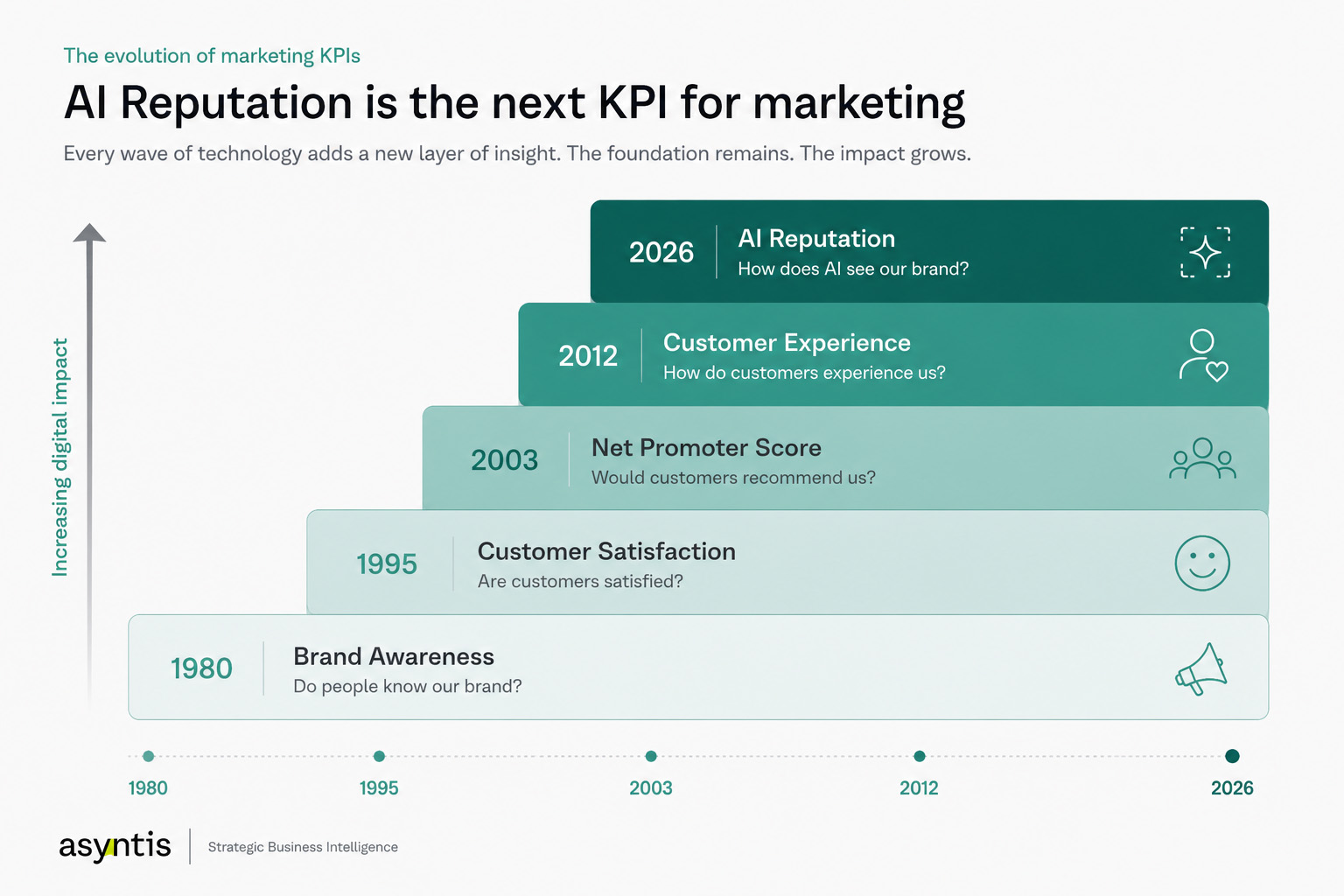
In the 1980s, marketing was mainly about one question: do people know our brand? Brands invested millions in advertising campaigns to build as much reach as possible. Brand Awareness became the benchmark for successful marketing.
By the mid-1990s, that changed. Organisations discovered that awareness alone was not enough. Satisfied customers stayed longer, bought more often, and contributed to a healthier business. Customer Satisfaction became a strategic KPI.
Net Promotor Score and Customer Experience
At the start of this century, another shift followed. Fred Reichheld introduced the Net Promoter Score (NPS), based on one simple question: “Would you recommend us?” Not satisfaction, but recommendation proved to be a much better predictor of growth.
Around 2012, Customer Experience was added. The digital world made it clear that no single touchpoint is decisive, but the full customer journey. Organisations invested heavily in websites, apps, service platforms, and omnichannel experiences. The customer journey became a discipline in its own right.
And now we are once again at the beginning of such a change. Not because consumers have suddenly changed. But because the way they find information is changing.
The first step in the customer journey is shifting
For twenty years, almost every online customer journey started in the same place: Google. If you wanted to be found, you invested in SEO. If you wanted to attract more customers, you optimised your website and content. That made sense, because Google was the gatekeeper between consumer and brand.
But that role is slowly shifting. More and more often, people no longer ask their question to a search engine, but to an AI assistant.
- “Which laptop suits me best?”
- “Which energy supplier is a good choice?”
- “Which accountant do you recommend for a growing business?”
- “Which health insurer best fits my situation?”
AI does not give a list of links. AI gives an answer.
It compares brands, weighs arguments, and makes recommendations. For the first time, an intelligent layer emerges between brand and consumer. And that has much greater consequences than we may realise.
Current KPIs tell only part of the story
The KPIs marketers use today tell only part of the full story:
- Brand Awareness shows how many people know your brand.
- Customer Satisfaction shows how satisfied customers are.
- NPS measures willingness to recommend you.
- Customer Experience reveals how customers experience their journey.
All relevant indicators. But none of these KPIs answers a question that is becoming increasingly important:
- How does AI see your brand?
- Are you mentioned when someone asks for advice?
- Are you recommended compared to your competitors?
- Are you seen as reliable? Innovative? Affordable? Or perhaps not at all?
That is a different question than we have been used to. And that is why there is a need for a new KPI.
AI Reputation
I call this new KPI AI Reputation. AI Reputation measures how leading AI systems interpret, position, and recommend an organisation during relevant decision moments. That does not mean AI becomes more important than the customer.
On the contrary, the customer remains central. But AI is increasingly the one making the first selection. It determines which brands even come into view before a consumer searches further on their own. AI thus becomes a new factor in the customer journey. And so organisations must also understand how AI sees them.
Every era has its own KPI
If you look back over the past forty years, you see a striking pattern. Every technological development brought a new way of measuring with it.
Not a revolution, but a new layer
AI Reputation does not replace Brand Awareness, Customer Satisfaction or NPS. And it certainly does not replace Customer Experience.
Just as Customer Experience never replaced NPS, AI Reputation adds a new dimension. Organisations will continue to focus on brand awareness, customer satisfaction, and customer experience in the future. But alongside that, a new question emerges:
How well does AI recommend our brand when a customer asks for advice?
Is the recommendation accurate, compelling, and aligned with our brand positioning?
The years ahead
I expect this to become a fixed part of marketing and brand strategy in the years ahead. Not because AI is a hype. But because AI is increasingly the first conversation partner for consumers. That means organisations will have to ask themselves new questions:
- Why does ChatGPT mention our competitor in this situation and not us?
- Why does Gemini position us as premium, while we want to convey affordability?
Why does AI give stronger recommendations for our competitors, even though we are the market leader?
How can we improve the quality of AI’s recommendations about our brand?
Those are not SEO or GEO questions. Those are AI Reputation questions.
A new discipline
To better understand and measure this development, I have spent the past few months developing a methodology to analyse AI Reputation. That has led to AIRepScore, a platform that examines how different AI systems interpret, position, and recommend organisations.
For me, AIRepScore is not the end goal, it is an instrument. The real subject, in my view, is AI Reputation. I believe we are at the beginning of a new discipline that will become just as self-evident in the coming years as SEO, Customer Experience, and NPS are today.
And I think this is only the beginning.