Will Volkswagen ever shake off the shadow of Dieselgate in the age of AI?
20 July 2026
AT
The Asyntis Team
Strategic Intelligence
What marketeers can learn from the AI Reputation of Volkswagen
Ten years after Dieselgate, Volkswagen has reinvented itself. Yet an analysis of the AI reputation of 25 automotive brands shows that the scandal continues to haunt the company. What could Volkswagen have done differently? And what can marketers learn from it?
In recent years, Volkswagen has done almost everything it could to put Dieselgate behind it. The group reached settlements with those affected, invested billions in electric vehicles and deliberately positioned itself as a key player in the transition to sustainable mobility. Yet our recent AI reputation analysis shows that this transformation has not fully filtered through to the way AI models assess the brand.
Volkswagen ranks 15th for AI reputation
In an analysis of 25 major automotive brands, Volkswagen ranks 15th for AI reputation, as measured by AIRepScore. That is remarkably low for one of the world’s largest car manufacturers. It is not because AI is unfamiliar with the brand. Quite the opposite: ChatGPT, Gemini, Claude, Mistral and Perplexity readily recognise Volkswagen as one of the world’s leading automotive brands.
The explanation lies elsewhere. Across virtually every model, the same historical association resurfaces: Dieselgate. How can Volkswagen ensure that, five years from now, AI associates the brand primarily with electrification rather than Dieselgate?
Ten years ago, this question probably would not have been asked. Today, it is becoming increasingly relevant. Consumers are using AI assistants more often to compare brands, choose products and seek purchasing advice. Alongside a brand’s reputation in people’s minds, a second reputation is emerging: the reputation it has in AI.
From brand perception to AI reputation
Traditional brand strategy focuses on how people perceive a brand. GEO is primarily concerned with visibility in generative search engines. AI reputation addresses a different question: what does AI then do with your brand?
How does AI interpret an organisation? Which attributes does it mention repeatedly? Does it recommend the brand to the right audience? And does that picture align with the positioning the company itself is trying to build?
Volkswagen offers a useful case for exploring this new challenge. The brand is large, well known and strategically relevant. At the same time, it carries the legacy of a reputational crisis that has been extensively documented online. That makes it an ideal example of how AI handles old and new brand narratives.
Content optimization itself is not the answer
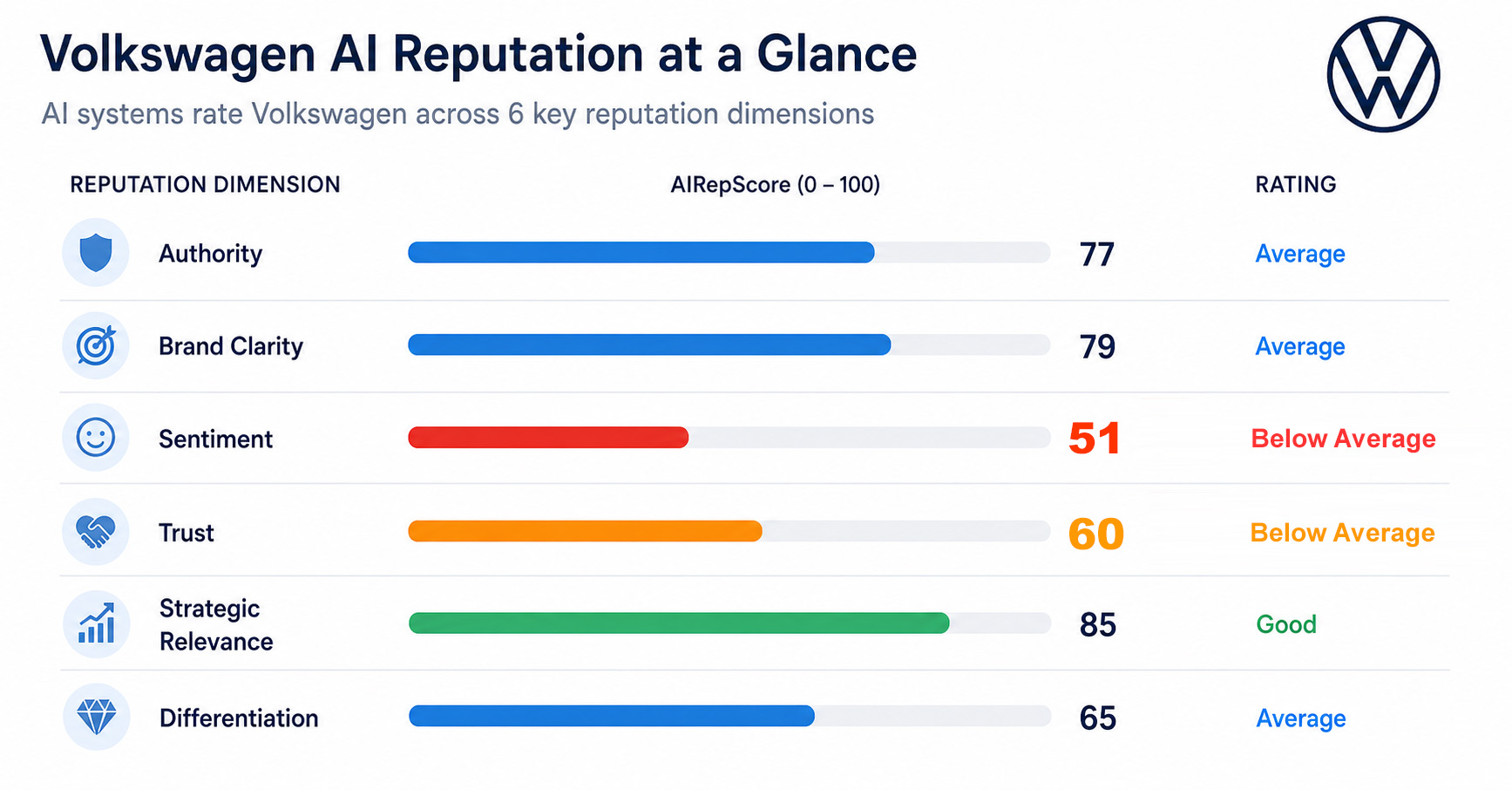
The analysis shows that AI has no difficulty finding or contextualising Volkswagen. The models consistently describe it as a global car manufacturer with a strong German engineering tradition, iconic models such as the Beetle and Golf, and a clear role in the transition to electric mobility. Volkswagen therefore performs well on dimensions such as Brand Clarity and Strategic Relevance. AI knows what Volkswagen is, where the brand comes from and why it remains relevant.
Volkswagen’s AI reputation: strong on strategic relevance, weak on trust and sentiment.
That is precisely what makes its low ranking so interesting. The problem is not visibility, awareness or relevance. It lies in the associations that continue to coexist with the brand’s new narrative.
Dieselgate keeps resurfacing
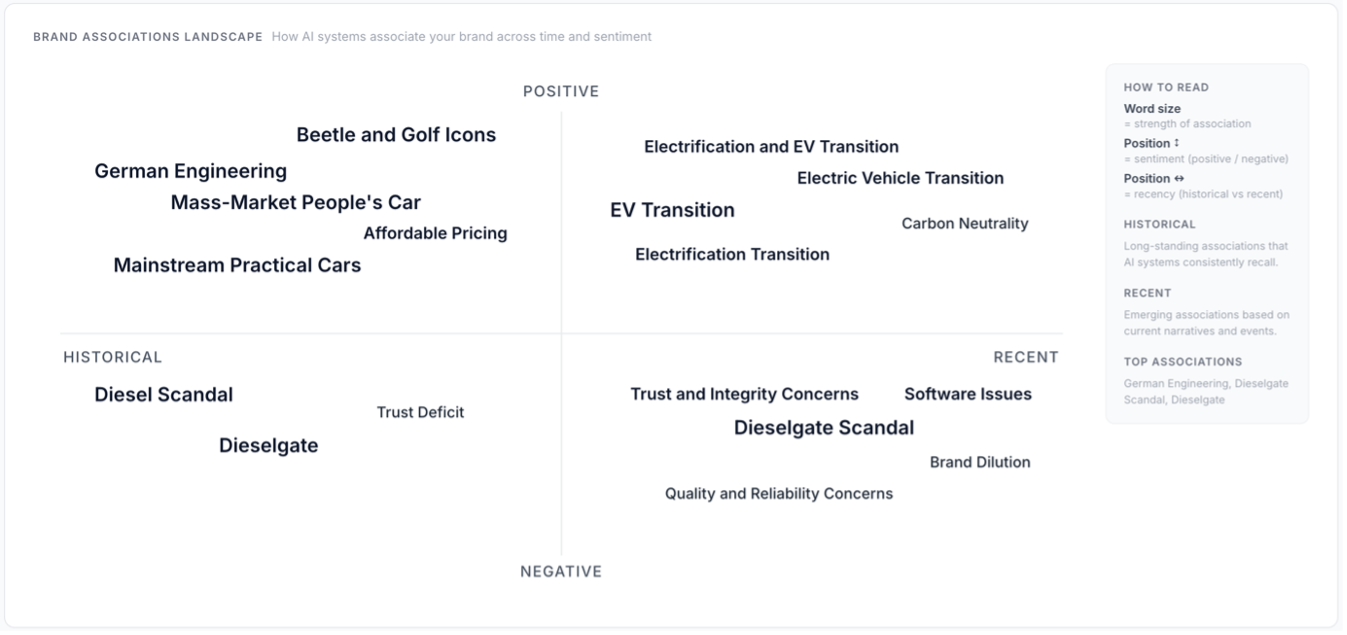
When we examined the spontaneous brand associations mentioned by the different models, a clear pattern emerged. On the positive side, the models cite German engineering, an iconic model heritage, electrification and the transition to EVs. But the same negative cluster also appears repeatedly: Dieselgate, loss of trust, questions about integrity, software problems, and concerns about quality and reliability.
The fact that Dieselgate is still mentioned is not surprising in itself. It was one of the biggest reputational crises in the modern automotive industry. What is more striking is the consistency. Even after years of investment in electric mobility, software and sustainability, Dieselgate remains one of the defining AI associations surrounding Volkswagen across every model tested.
Spontaneous associations with Volkswagen mentioned by AI systems.
AI forgets differently from people
This is where the distinction between AI reputation and traditional reputation management becomes clear. People change their view of a brand through campaigns, new products, personal experiences and what they hear from others. As a result, old associations can gradually fade into the background.
AI works differently. New information does not automatically replace old information. Language models combine historical events with recent signals. They weigh what has been published, discussed and cited over many years. As a result, old and new narratives continue to exist side by side. AI therefore sees Volkswagen not only as a brand associated with German engineering, electrification and iconic models. It still also sees Volkswagen as the brand behind Dieselgate. The new narrative has been added, but the old one has not disappeared.
The strategic question is changing
For marketing and communications teams, this represents an important shift. The question is no longer simply: how do we communicate that we have changed? It is also: which information, sources and signals does AI use to understand our brand?
That is a different challenge. Campaigns can move people. AI primarily looks for patterns in the information available to it. A brand can tell a new story, but that story must also appear in sources that AI recognises as credible.
For Volkswagen, this means the EV transformation is not just a product and communications challenge. It is also a reputational challenge involving data, sources and public evidence. What matters is not only campaign claims, but also:
independent quality assessmentsconsumer research
ADAC and TÜV results
battery reliability data
demonstrable software improvements
sustainability certification
long-term policy fot customer satisfaction
What if AI reputation had been measured?
If AI reputation had been measured systematically immediately after Dieselgate, Volkswagen could have tracked not only the recovery of consumer trust, but also the associations AI systems attached to the brand. It would have become clear sooner whether the evidence supporting the new brand narrative was growing stronger than the evidence reinforcing the old one.
This is the most important lesson. AI has little patience for isolated claims. A slogan, campaign or promise may have an impact in the market, but for AI it is usually just one signal among thousands. What carries more weight is what recurs over time in credible sources: journalism, expert publications, reviews, official documentation, independent research and current news coverage.
A new priority for marketers
Volkswagen is not unique. Every brand facing a reputational crisis, a strategic change of direction or a shifting market position must confront the same question: how does AI translate this for my customers? For marketers and communications professionals, this creates a new area of focus. AI reputation is not simply about being found in AI. It is about how AI understands, compares and recommends your brand at moments that influence customer decisions.
The question for brands is therefore becoming increasingly concrete: if a customer asks an AI assistant tomorrow which brand to choose, what story will AI tell about yours?
Methodology
This analysis is based on a selection of 25 major automotive brands, compiled using Focus2Move’s global sales rankings. The brands were evaluated using the AIRepScore framework, which measures how leading AI systems perceive, compare and recommend brands across six reputation dimensions: Authority, Brand Clarity, Trust, Strategic Relevance, Differentiation and Sentiment.
Following Volkswagen’s notably low ranking, an additional analysis was conducted using GPT, Claude, Gemini, Mistral and Perplexity. This examined recurring brand associations, differences between models, current online signals and additional AI brand-perception scans to identify the main drivers of Volkswagen’s AI reputation.